Blog Articles
Educator Spotlight: Eric Handman, University of Utah
March 31, 2026 — 6 minutes
When Drones Take the Stage: How a Dance Professor Choreographed the Impossible
Category: Educator Spotlights | Drone Light Show
When Eric Handman watched Intel’s drone display at the 2018 Winter Olympics, he didn’t see a technology demonstration. He saw choreography.
“Drones are choreographable,” he thought. “Dancers are choreographable. Can those things be brought together?”
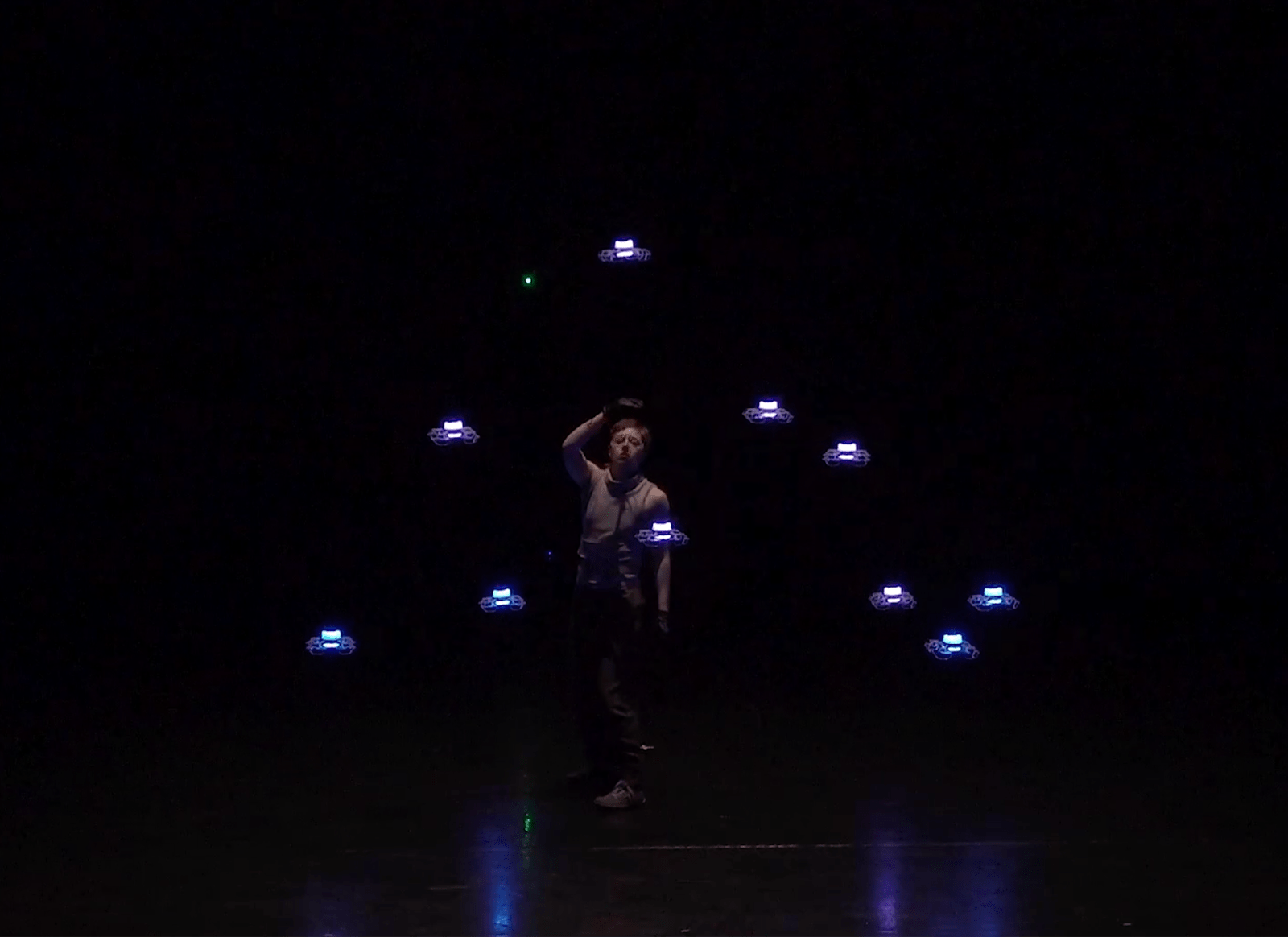
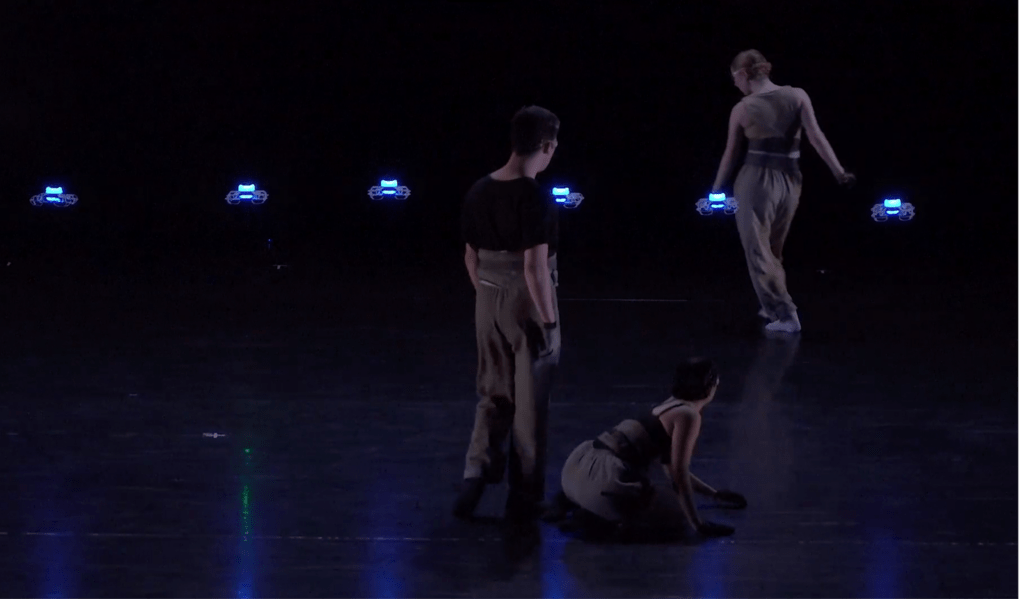
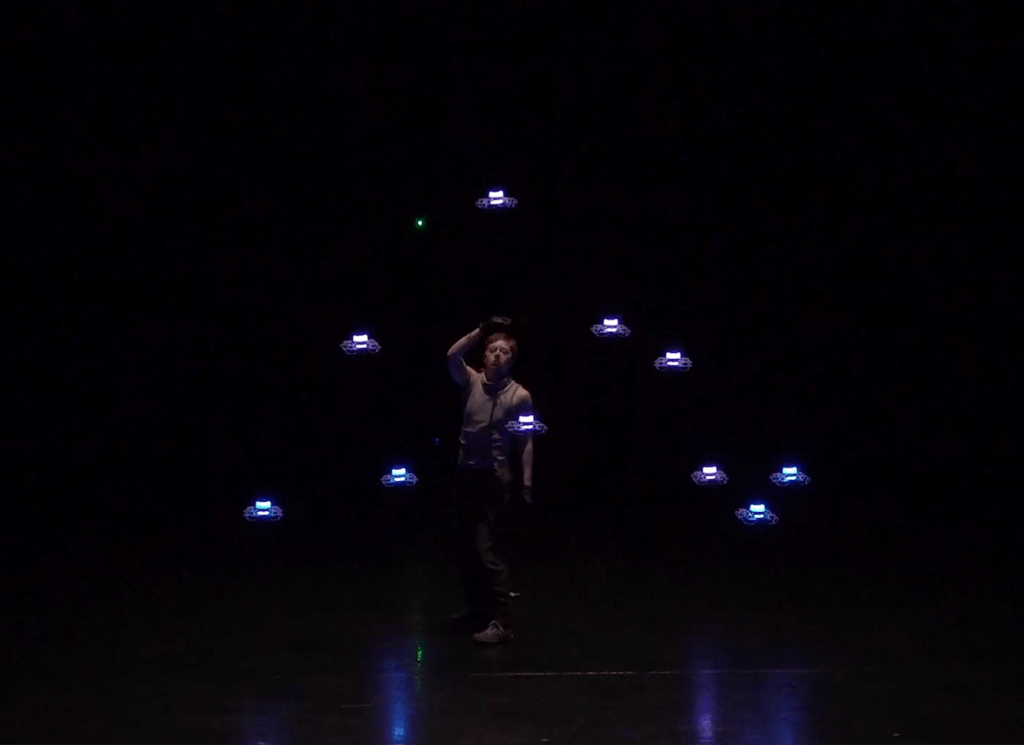
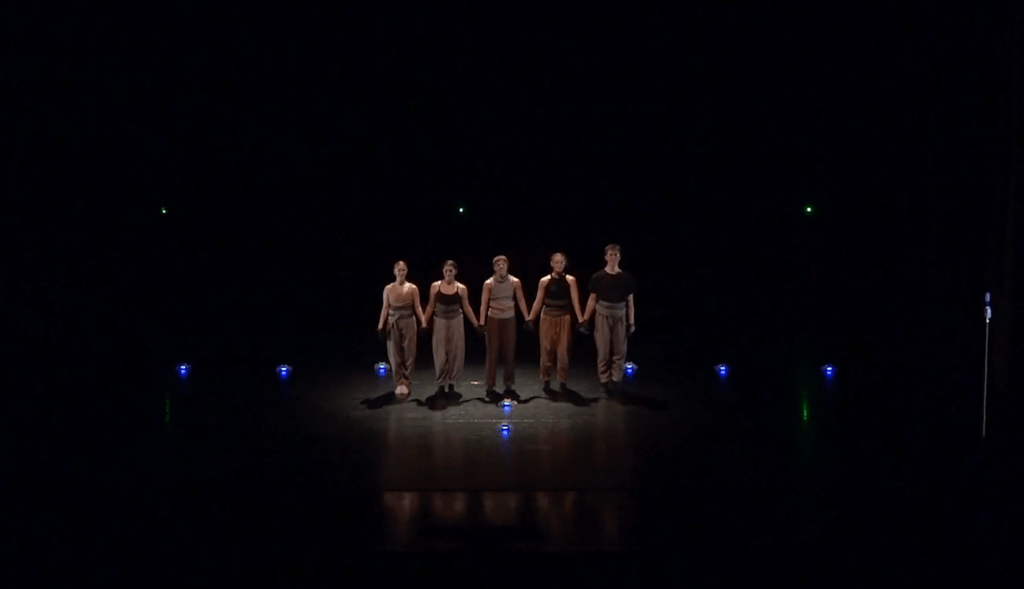
Six years later, Handman — an Associate Professor in the School of Dance at the University of Utah’s College of Fine Arts — answered that question in front of a live audience. The result was Scylla System v1: a 20-minute stage work featuring ten DroneBlocks Indoor Light Show drones and five human dancers, performed live eight times in Salt Lake City. Nothing quite like it had ever been done before.
The Long Road to “Bingo!”
The journey from idea to opening night took seven years and more than a few wrong turns.
Handman’s early experiments started with a basic hover drone, then a custom-built drone in a motion capture studio. Motion capture, he quickly learned, was not portable. He moved on to DJI Mavics for indoor flight — but indoor Mavics are, in his words, “not the drones we were looking for.” The team’s joke stuck because it was true: they were too difficult to manage and too unpredictable in close quarters with dancers.
The breakthrough came when a colleague recommended Tello drones as a potentially choreographable platform, which led Handman to reach out to DroneBlocks. After sharing an early video of his work, the conversation that followed pointed him to the DroneBlocks Indoor Light Show Kit.
“Bingo!” he said. “Let’s see if we can write a grant for that.”
He had no idea yet what he was going to do with it. That, it turns out, was exactly the point.
Building Something No One Had Done Before
Scylla System v1 was two years in the making, supported by two separate grants secured by Handman—the first to acquire equipment and initiate testing, and the second to facilitate full rehearsals with students. The project relied on the expertise of Virginia Tech faculty members Scotty Hardwig, a movement artist and live theatre specialist from the School of Performing Arts, and Zach Duer, a creative coder and sound designer from the School of Visual Arts who managed the drone choreography and flight programming.
“Zach would show me the simulation and I’d say, ‘okay.’ Then we’d run it live with the actual drones and I’d say, ‘oh — NOW I get it!'”
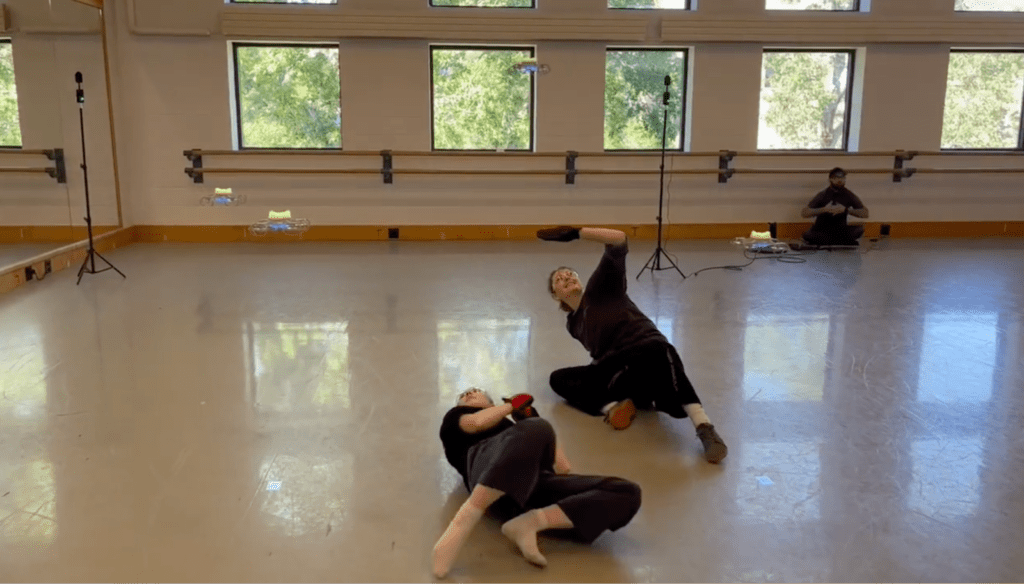
The production calendar was tight. Collaborators arrived in June. Performances opened in September. Handman cast his student dancers in August and spent the first two weeks building trust between them — before a single drone went in the air. The dancers needed to bond as a team before they could be asked to share a stage with ten autonomous machines buzzing overhead.
What the Drones Taught Them
Day one with the DroneBlocks kit was, by Eric’s own description, chaos.
The team didn’t know that the battery packs needed to face the base station. Without that alignment, the drones refused to cooperate. They swapped battery packs, re-read the manual — which at the time was only available in Mandarin — ran Google Translate, and started over. By the end of day one, they had a handle on setup. Iteration became their operating mode.
One of the project’s biggest discoveries came entirely by accident. Scotty Hardwig started exploring how to interact physically with the drones and found the infrared sensor on the underside of each unit. Place your hand beneath it, and the drone flies up.
“That changed everything,” Handman said. Suddenly dancers weren’t just avoiding the drones — they were communicating with them.
As a choreographer, Handman knew his dancers needed new skills to share the stage safely with machines. Scotty Hardwig designed the training regimen for the dancers to evade and interact with the drones.
Their training emphasized evasive, functional physicality — crawling, diving, rolling — along with omnidirectional situational awareness. In most dance training, what’s happening above you doesn’t matter. Here, it was everything. The rehearsal rules were straightforward: avoid the drones, be mindful of the ones you can’t see, move with intention not flash, use the infrared sensor, and — when a drone goes down — give it last rites.
That last rule came from Handman’s collaborator Scotty, who told him early on: “You’ve got to accept drone failure.” So the team built it into the show. If a drone collided and fell to the stage, the nearest dancer would pause, perform a small gesture over it, pick it up, and carry it to the side of the stage for its next takeoff position. Borrowed from fight choreography — how to drop your knife and keep it in the show — it became one of the most human moments of the performance.
The Show Must Go On (And It Did)
Sixteen minutes before opening night, Zach appeared backstage with a problem. There was a short circuit in the main base station. No data could transfer from the computer to the drones.
Luckily, DroneBlocks had shipped a backup kit of repeaters after an earlier short circuit during rehearsals. The theater’s technical director opened the backup unit, removed the circuit board, replaced the one in the base station, and soldered it back in — in under five minutes.
“Somewhere, your art emerges in that gap between what you planned to do and what you wind up doing,” Handman reflected.
All eight performances went off without a hitch. Handman was in the audience for every one of them, sweating the entire time.
What the Audience Experienced
The piece is structured in three acts, each designed to create a different kind of pressure for the dancers. The opening section establishes mystery — dancers gesture, discover, start to understand the world they’re in. The middle section becomes a game of evasion and intensity as drones and dancers compete for space. The final section — what Handman calls an “ethereal tornado” — moves toward harmony.
The audience never learned whether the drones were piloted or autonomous. That mystery was intentional.
“That state of uncanniness,” Handman explained, “is something I find very interesting to work with theatrically.”
His dancers didn’t just survive the experience — they loved it. They started naming the drones. They bonded with them.
What Comes Next
Slight rephrasing: Handman is already looking ahead to the next iteration of Scylla System. More drones, more dancers, more complex situations. He is also excited about helping other artists attempt similar projects, curious to see what different choreographers would discover with the same tools.
His biggest dream for the technology? Flocking behaviors — murmuration-like movement where a single dancer’s movement could influence an entire swarm of drones through collision avoidance and boid behavior. “Something extremely beautiful,” he said.
Advice for Educators Ready to Try Something New
For educators thinking about picking up a DroneBlocks Light Show Kit and attempting something ambitious, Handman offers this:
“You don’t need to know everything to get involved. Every medium pushes back on its artist and forces you to adapt. Working with drones as an artistic medium forced us to change. Mentally budget for that — it’s a resilience practice.”
In other words: accept the chaos. The art lives in there somewhere.
DroneBlocks is proud to support educators like Eric Handman who are pushing the boundaries of what’s possible with drone technology. If you’re interested in bringing the DroneBlocks Indoor Light Show Kit to your school, performance space, or creative project, your can create a free trial to the DroneBlocks Platform HERE.
Tags: Educator Spotlight | Drone Light Show | University of Utah | Dance | Arts Integration | STEAM | DroneBlocks Light Show Kit
Give Your School District Wings
Talk with DroneBlocks about enrolling your school in the most innovative STEM education programs.